

Guarantor for Student Accommodation: Your Options
You have found the course, and maybe pictured the room. Then one line on the booking form stops you: you will need a guarantor. It is one of the most common worries families raise, and it is rarely as large as it first looks.
A guarantor for student accommodation is someone in the UK who agrees to pay your rent if you cannot, and who can be asked to cover damage too. Most providers expect that person to live in the UK. This guide walks through who can be one, what they agree to, and your options if you have no UK guarantor, in plain terms.
Key Takeaways
- A guarantor promises, in writing, to pay your rent and often to cover damage if you do not.
- Guarantors are commonly asked to earn about three times the annual rent, a norm, not a law (Whitegates, 2026).
- No UK guarantor? A professional service can stand in, with Housing Hand from about £40 a month.
- At Urban Student, whether you need a guarantor depends on your booking, so it is worth asking us early.
What is a guarantor for student accommodation?
A guarantor is your backer on paper. It is usually a parent or close family member in the UK who promises to pay your rent if you ever cannot, and who can be asked to cover the cost of damage as well. Landlords ask for one because most students do not yet have a UK income or credit history to point to. Citizens Advice describes a guarantor as someone who agrees to pay your rent if you do not, for example a parent or close relative (Citizens Advice, Using a guarantor, 2026).
The word simply means someone who stands behind your rent. That is why a family overseas, however willing and able, often cannot fill the role for a home rented here. It is a location problem, not a question of trust. For the wider picture of what your rent actually covers, our guide to what is included in your rent pairs well with this one.

Who can be a guarantor, and what do they need?
Normally a parent, guardian, or close relative who lives in the UK, owns a home or is in steady work, and can show they earn comfortably more than the rent. In 2026, University of London Housing Services notes that most landlords and agents want a UK-based guarantor (University of London Housing Services, Guarantors, 2026).
How much is comfortably more? Whitegates puts the common ask at about three times the annual rent, roughly 36 times the monthly rent (Whitegates, What is a rent guarantor?, 2026). This is an industry convention set by each landlord, not a legal rule, and no single figure is set in law.
Can a grandparent do it? Yes, if they meet the same tests: UK-based, and able to cover the rent from income or savings. Age is rarely the barrier. A steady income and a UK address are what a landlord actually checks.
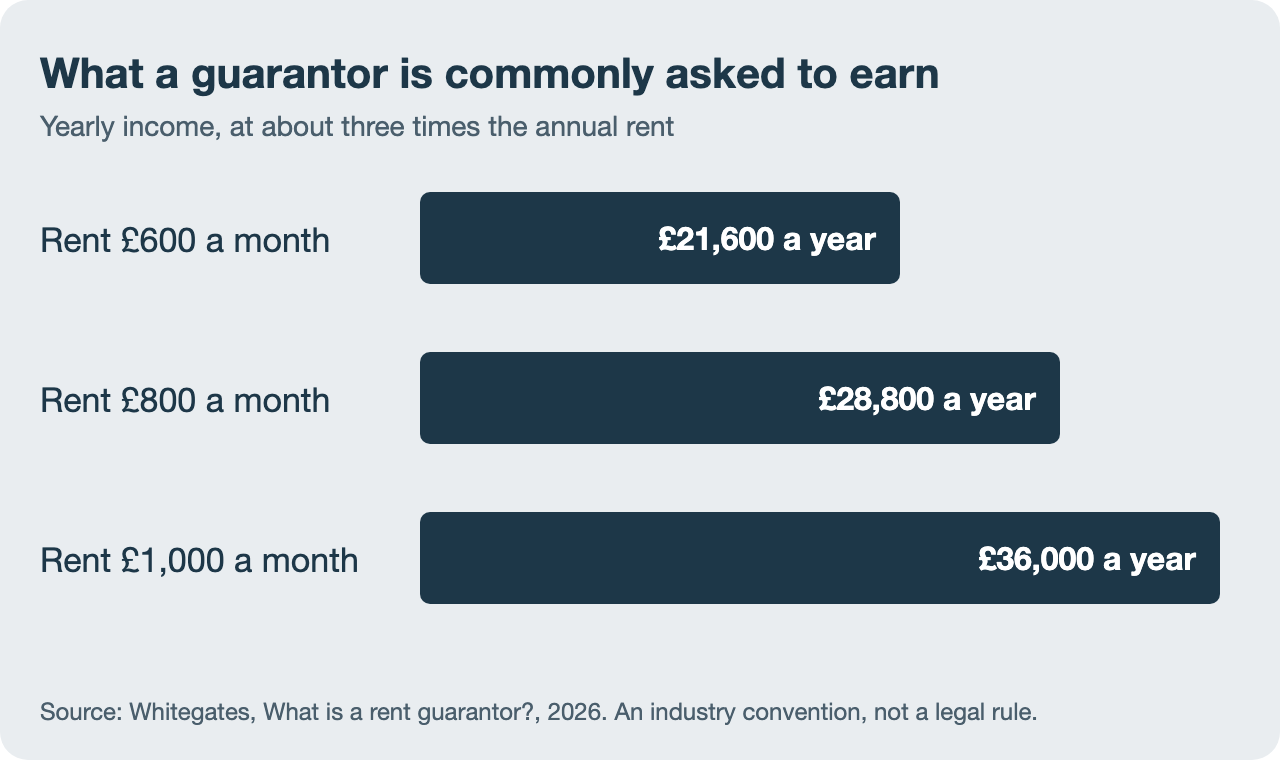
For a family living abroad, the sum matters less than the catch inside it. The earnings test still assumes someone based in the UK. That location rule, not the income, is usually the real barrier.
What a guarantor actually agrees to
It is worth knowing exactly what you are agreeing to before you sign, because it is more than most people expect. A guarantor agrees to pay any rent you miss, and often to cover damage beyond your deposit. University of London Housing Services explains that a guarantor reimburses the landlord for unpaid rent and can be liable for damage too (University of London Housing Services, Guarantors, 2026). The agreement is usually a signed, written one, so it is worth reading closely, because the length and limits of that promise vary.
In a shared house, watch for a phrase called joint and several liability. Citizens Advice explains that under a joint tenancy the guarantee commonly applies to all of the rent, not just one person’s share (Citizens Advice, Using a guarantor, 2026). So if other housemates fall behind, you could be asked to cover it. If you are backing one person in a group, ask the provider to limit your promise to your own student’s room and rent. Many will put that in writing when asked.
So how do you protect yourself? Read exactly what you are covering, and for how long. Check whether it is your share or the entire house. Keep your own copy of the agreement. A clear, single-room promise is far easier to stand behind than an open-ended one, and a provider who explains it willingly is telling you something reassuring about how they work.
What if you do not have a UK guarantor?
You still have clear routes, and this is where most international students land. You can use a UK guarantor if you have one, pay a professional guarantor service to stand in, or pay your rent upfront where the provider allows it. You are far from alone here. In 2024, the National Union of Students found that 40% of student renters struggled to secure a guarantor, and it was especially hard for those arriving from abroad (National Union of Students, Student Housing and Renters, 2024).
If there is no one in the UK you can ask to be your guarantor, a professional guarantor service is the usual answer. It acts as your guarantor for a fee, so you do not need to know anyone here at all. More on what that costs in a moment.
One point many guides still get wrong is worth flagging. In 2026, the Renters’ Rights Act capped rent in advance at one month for ordinary private lets from 1 May (GOV.UK, Tenant Fees Act 2019 statutory guidance, 2026). So the old tip of paying a whole year upfront to a private landlord no longer works for those tenancies. It is always worth checking exactly what any provider asks before you commit. Families who want steady guidance through all this can read our guide for parents and carers.

How much does a guarantor service cost?
Less than most families fear, and the figures are clear once you see them side by side. A professional service charges a fee to stand in as your guarantor. Housing Hand, the largest UK service, starts from about £40 a month plus a one-off £20 sign-up fee (Housing Hand, Rent Guarantor Service UK, 2026).
| Service | Typical cost | Worth knowing |
|---|---|---|
| Housing Hand | From about £40 a month, plus a one-off £20 sign-up fee | The largest UK service; reports around 98% acceptance |
| RentGuarantor | A fee based on your rent, plus a £20 application fee | A decision usually within hours; National Residential Landlords Association partner |
| UK Guarantor | From £295, depending on the rent | Lets you pay your rent in instalments |
| Goodlord | A one-off fee equal to one month’s rent | Covers the whole tenancy, up to three years |
Sources: Housing Hand, RentGuarantor, UK Guarantor and Goodlord, all 2026. Re-check every fee before you pay, as prices change. The fees and who accepts each service are worth comparing side by side before you commit.
Read the small print before you pay. Some newer services market themselves as no UK guarantor needed, yet still ask you to add a credit card or a second signer as backup. Always confirm your chosen home accepts a given service first. Paying for one your building will not take is money gone for nothing.
Booking from overseas with Urban Student

Here is where the weight lifts. With us, a guarantor is often far less of an obstacle than it first seems, and for some bookings you may not need one at all. What applies to you depends on the apartment and your booking, so tell us the apartment you have in mind and we will walk you through exactly what is needed. Your deposit is four weeks’ rent, below the five-week legal maximum set by the Tenant Fees Act 2019 (GOV.UK, 2026).
If you would rather spread the cost and have no UK guarantor, we recommend Housing Hand. The documents you actually need are refreshingly few: your passport, your university offer letter, and proof of funding or a guarantor. That is really it.
Deposits can be paid through WeChat Pay, and a Mandarin-speaking team can walk your family through each step. Across fifteen boutique properties within walking distance of the University of Bristol, the bills are included with no usage caps, and a two-year fixed rent option is there if you want the cost settled for the long run. At Urban Student we know residents by name, and parents are always welcome to call. To see how we look after students arriving from abroad, read how we support international students.
Frequently asked questions
Can a grandparent be a guarantor?
Yes. A grandparent can be a guarantor as long as they meet the usual tests: living in the UK, and able to cover the rent from income or savings. Age itself is rarely the issue. In 2026, most landlords check a UK address and steady finances rather than who the person is (University of London Housing Services, 2026).
How much does a rent guarantor cost?
It depends on the service and your rent, but the figures are modest. In 2026, Housing Hand starts from about £40 a month plus a one-off £20 sign-up fee (Housing Hand, 2026). Goodlord charges a one-off fee equal to one month’s rent, and UK Guarantor starts from £295. Always confirm your building accepts the service first.
How do I get a guarantor if I don’t know anyone in the UK?
Use a professional guarantor service. It acts as your guarantor for a fee, so you do not need to know anyone in the UK yourself. In 2026, Housing Hand reports around 98% acceptance across UK rentals (Housing Hand, 2026). At Urban Student, depending on your booking you may not need a guarantor at all, so it is worth asking us.
How do I protect myself as a guarantor?
Read exactly what you are agreeing to before you sign. Check whether you are covering your own student’s share or the whole house, and for how long. In a shared house, you can ask to limit your promise to one room and rent. Citizens Advice notes it may be possible to negotiate a guarantee that is confined to your own rent or any damage you cause, and the agreement must be in writing, so keep your own copy (Citizens Advice, Using a guarantor, 2026).

Ready to book your Bristol home?
None of this should feel like a wall. A UK guarantor is one route, a professional guarantor service is another, and depending on your booking there is often a simpler way still. With us, the paperwork is light, the team is real, and the answers are honest. If you are moving to Bristol and want calm, clear booking, take one simple step today. Browse all our Bristol properties, then contact us to book a viewing. We like talking to families, and we will tell you exactly what you need.
About the author. Jonathan Brecknell helps run Urban Student, a family of boutique student residences in Bristol managed by Urban Creation. Urban Student has looked after students coming to the University of Bristol for more than 20 years, across 15 properties within walking distance of campus. He writes about booking, bills, and settling in for students moving to Bristol.